


27 Feb Forty Years of Survival, Twenty-Three Years with a New Liver, and a Life Redefined Through Sport
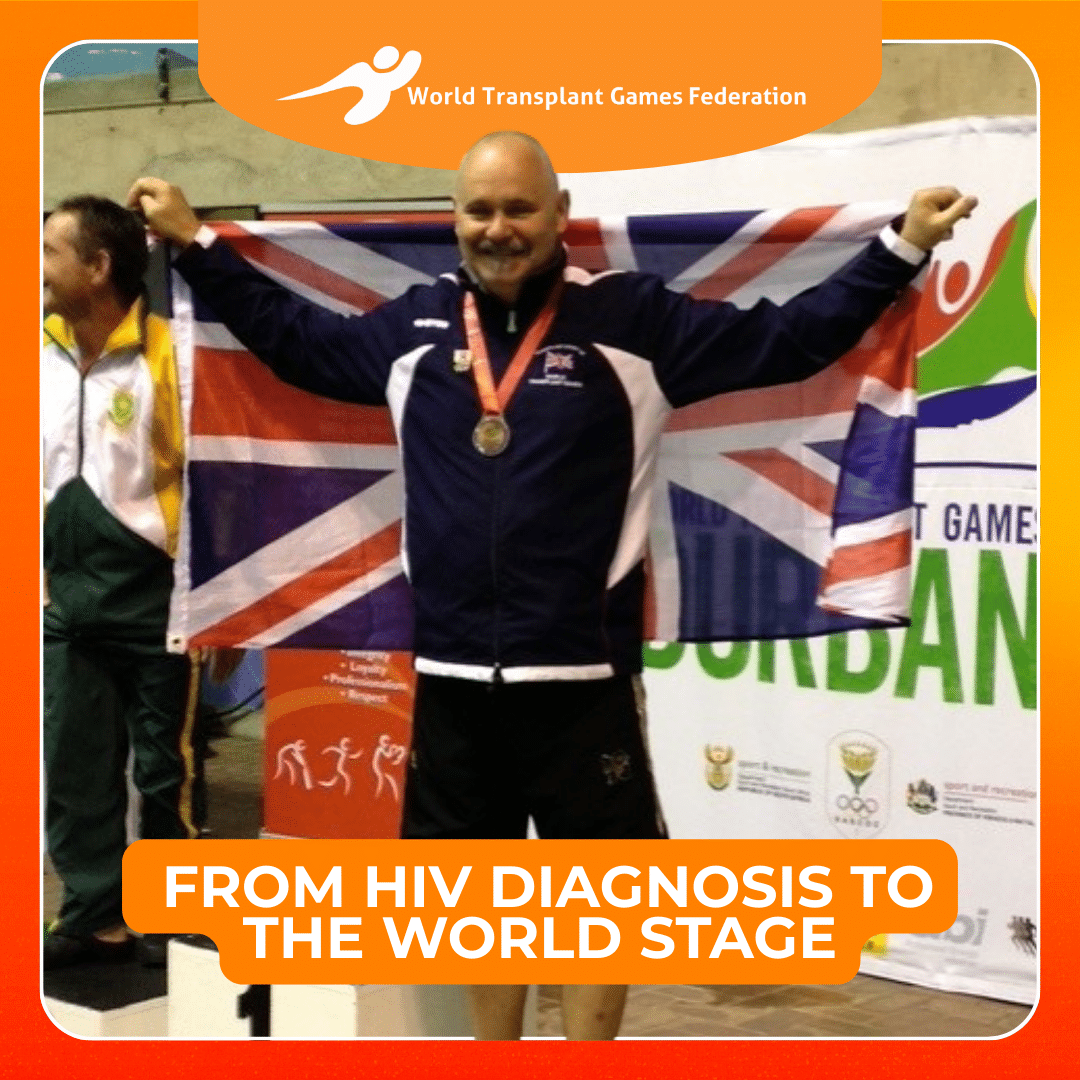
Simon’s first British Transplant Games took place in Norwich in 2004. His first World Transplant Games followed in London, Ontario, Canada in 2005.
But his journey began nearly two decades earlier.
On 25 October 1985, Simon received an HIV-positive test result — then referred to as HTLV III. Testing had only just become available that year. At the time, it was widely understood that most people diagnosed would die within a few years.
The year before, in 1984, he had already received a positive hepatitis B diagnosis. He likely contracted both viruses around the same time, though that was not known then. His body was unable to clear the hepatitis virus — something recognised medically, but not common.
Like many others diagnosed in the mid-1980s, Simon believed his life expectancy was short.
But he survived long enough to benefit from antiretroviral therapy — a medical breakthrough that transformed HIV treatment and changed the course of the epidemic.
The journey, however, was not without complications.
In 2001, before beginning medication, Simon was diagnosed with AIDS after developing PCP pneumonia, an AIDS-defining illness. When antiretroviral therapy successfully restored his immune system, it also triggered reactivation of his hepatitis B, which began attacking his liver.
While lying in a hospital bed, he was told the only option left was a liver transplant.
Simon initially believed this was impossible because of his HIV status. Instead, he was told something remarkable — that modern HIV medication was now so effective that people living with HIV could safely undergo organ transplantation and live long, meaningful lives.
After extensive testing and a long period of uncertainty about being listed, Simon received his new liver on 30 January 2002 at King’s College Hospital in London, while living in Brighton.
His recovery was strong. Within three months, he was cycling along the seafront.
Two years later, he entered his first British Transplant Games in Norwich. With no expectations, he competed in running, cycling and swimming — winning gold in the backstroke.
That gold medal earned him selection for the British team at the 2005 World Transplant Games in London, Ontario. At 48 years old, the older end of the 40–49 category, he secured bronze in the 100m backstroke — a medal he still considers one of his proudest achievements.
The journey continued.
At the next World Games in Bangkok, now at the younger end of his age category, he returned home with gold medals in swimming. Through transplant sport, he has competed in China, Australia, Sweden, Spain, South Africa, the United Kingdom and Germany. The only World Games he has missed since his transplant were in Argentina and Perth.
At the 2025 Games in Dresden, twenty years after his first British Games, he once again found himself at the older end of his category. This time there was no medal — but there was perspective. He now looks ahead to Belgium in 2027, where he jokes he will be “young again” in his age group — even if not in reality.
Simon is clear about one thing: without his liver transplant, he would not have survived another month.
He remains profoundly grateful to his donor, their family and the medical team who made his transplant possible. His way of honouring them is simple — to keep showing up at the World Transplant Games and always strive for gold.
His story also carries another important message.
Today, it is scientific fact that a person living with HIV who maintains an undetectable viral load cannot transmit the virus. This is known as U=U — Undetectable equals Untransmittable — or treatment as prevention. Organ transplantation for people living with HIV is now a reality in many countries, including South Africa, where HIV-positive donor organs are successfully transplanted into HIV-positive recipients.
On 25 October 2025, Simon marked 40 years since his HIV diagnosis. He has now lived 23 years with his transplanted liver.
His life is a testament to medical progress, resilience, visibility and the power of sport.
What once seemed like the end became a new beginning.
And he continues to swim forward. 💙